
Cooling Towers Manufacturer in India for Industrial, Commercial, and Process Cooling Applications
SF Cooling Towers offers FRP cooling towers and industrial cooling equipment for businesses across India that require effective heat removal and reliable process-water cooling. From manufacturing plants and engineering facilities to chemical processing units and commercial buildings, suitable cooling equipment helps maintain operating temperatures and supports efficient industrial operations. Our cooling tower options can be evaluated according to the required cooling capacity, process heat load, water circulation, installation conditions, and maintenance requirements.
Our product range includes FRP cooling towers, fill media, water distribution systems, drift eliminators, and fan and motor assemblies for a variety of industrial applications. For projects across major industrial centres in India, equipment selection should account for circulating-water flow, seasonal climate variations, site-specific wet-bulb temperatures, water quality, electrical requirements, and available installation space. Since environmental conditions differ across the country, appropriate equipment sizing, material selection, and preventive maintenance are important considerations when planning a dependable industrial cooling system.
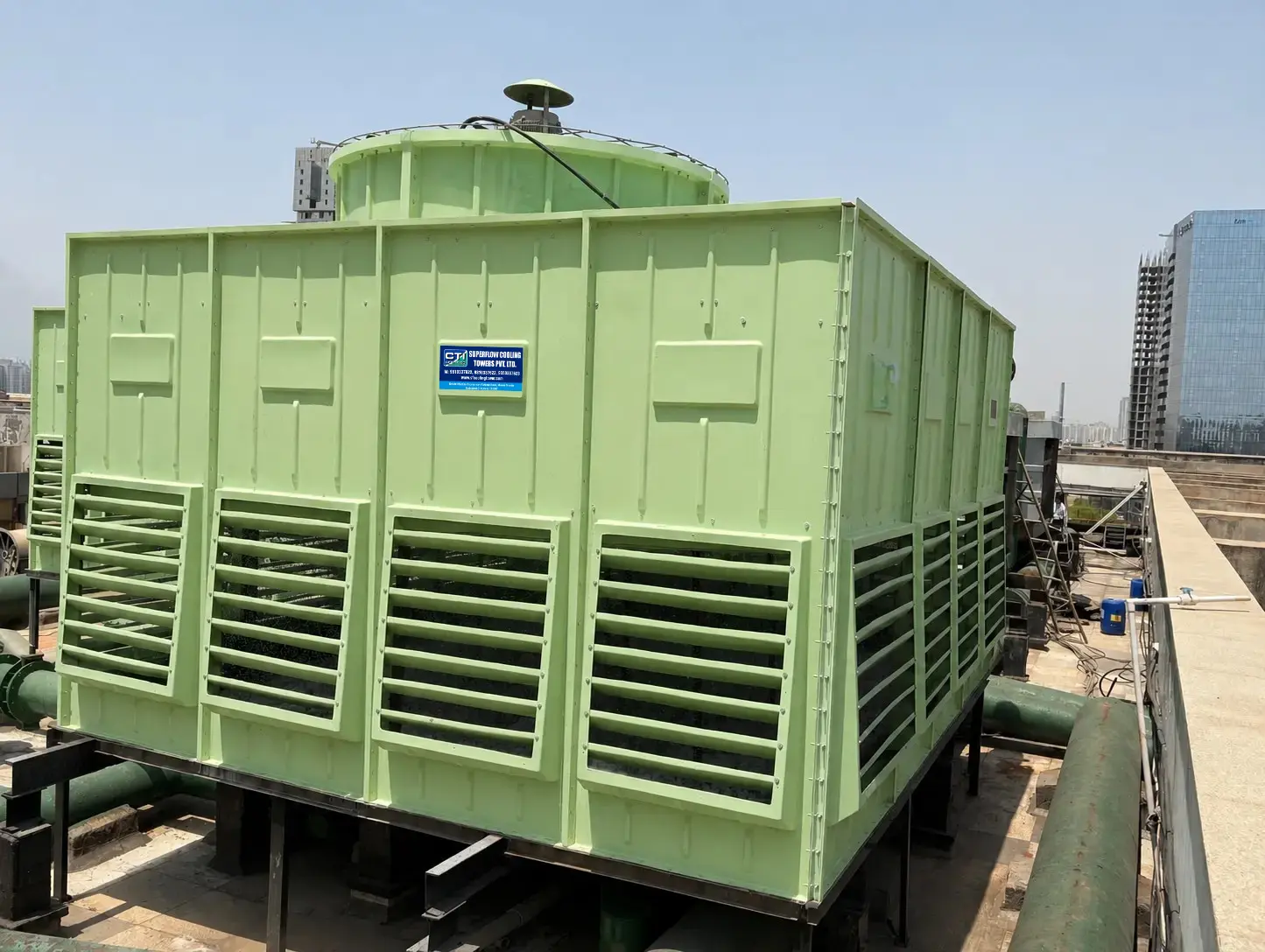
Industrial Cooling Solutions for Manufacturing and Process Industries
SF Cooling Towers provides industrial cooling equipment and FRP cooling tower options for businesses seeking practical solutions for heat rejection and circulating-water management across India. From production facilities and heavy engineering plants to commercial infrastructure and process industries, cooling towers help remove excess heat and maintain the water temperatures required by connected equipment. The right system depends on the application's thermal load, operating schedule, water circulation requirements, and installation environment.
As businesses evaluate a Cooling Towers Manufacturer in India, it is important to look beyond the equipment's physical dimensions and nominal capacity. Industrial cooling requirements differ according to production processes, machinery specifications, ambient conditions, and utility systems. SF Cooling Towers offers equipment options that can be assessed for different applications, with the final configuration determined by technical requirements, project feasibility, and service availability.
Industrial Cooling Needs Across India's Manufacturing Sector
India's industrial sector includes automotive production, metal fabrication, plastic moulding, pharmaceutical manufacturing, food processing, chemical production, power generation, and commercial air-conditioning. Many of these operations use circulating water to transfer heat away from machinery, condensers, heat exchangers, and process equipment. A suitably selected cooling tower helps reject this heat so the water can return to the connected system for reuse.
Different industries require different cooling arrangements. A plastic moulding facility may need stable cooling-water temperatures for production equipment, while an engineering plant may require heat removal from machinery and auxiliary systems. Commercial buildings with water-cooled chillers have their own operating parameters and space limitations.
When planning an industrial cooling installation, the application should be assessed individually rather than assuming that one cooling tower design will suit every facility.
- Automotive and engineering: Cooling for compatible manufacturing machinery and production utilities.
- Plastic processing: Circulating-water temperature control for injection moulding and related equipment.
- Chemical and pharmaceutical industries: Heat rejection for suitable process-water circuits and heat exchangers.
- Food and beverage production: Cooling support for compatible machinery and utility systems.
- Metalworking and fabrication: Heat removal from suitable industrial equipment and auxiliary processes.
- Commercial HVAC: Heat rejection for water-cooled chillers and central cooling installations.
FRP Cooling Tower Construction for Diverse Operating Environments
Fiberglass Reinforced Plastic (FRP) is used in cooling tower construction because of its relatively low weight and resistance to corrosion under suitable operating conditions. Depending on the material grade and design, FRP construction can be considered for installations where moisture exposure, handling requirements, and maintenance planning influence equipment selection.
Material selection should account for the conditions at the actual installation site. Temperature exposure, circulating-water characteristics, airborne contaminants, rainfall, and the condition of supporting components can all influence long-term equipment performance. Fasteners, structural supports, electrical components, and mechanical assemblies should also meet the project's specifications.
A cooling tower's thermal performance depends on the entire system. Fill media increases the contact area between air and water, distribution nozzles help spread water across the cooling section, and the fan assembly provides the required airflow. Drift eliminators limit water droplet carryover, while the basin collects cooled water for recirculation.
Cooling Tower Configurations for Different Applications
Industrial cooling equipment is available in several configurations to accommodate different capacities, airflow arrangements, and installation layouts. Choosing an appropriate design requires consideration of both thermal performance and the practical requirements of the site.
Bottle-Type Cooling Towers for Compact Installations
Bottle-type cooling towers have a shaped outer casing designed around the unit's airflow and water distribution arrangement. They may be considered for applications where the rated cooling duty, footprint, and service clearances match the facility's requirements. Foundation dimensions and piping connections should be confirmed before installation.
Square Cooling Towers for Flexible Plant Layouts
Square cooling towers can accommodate particular footprint requirements and, depending on the design, modular installation arrangements. These systems may be evaluated for manufacturing facilities and industrial utility areas where equipment positioning, water flow, and access for maintenance need careful planning.
Counterflow Cooling Towers for Vertical Air and Water Movement
Counterflow cooling towers direct air upward while water moves downward through the cooling section. This arrangement supports heat and mass transfer between the two streams. Its suitability depends on the required cooling capacity, fill characteristics, airflow, and the ambient design conditions of the installation.
Crossflow Cooling Towers for Alternative Airflow Distribution
Crossflow systems allow air to move horizontally across water flowing downward through the fill. Depending on the model, this arrangement can provide convenient access to water distribution components. The choice between crossflow and counterflow designs should reflect the required performance, available space, maintenance preferences, and overall system layout.
Technical Factors That Influence Cooling Tower Capacity
Correct cooling tower selection starts with understanding how much heat must be removed and the temperature at which water needs to return to the process. Selecting equipment based solely on a general capacity estimate may result in unsuitable operating performance.
Before comparing equipment options, establish the following technical details:
- Process heat load: The amount of heat transferred into the circulating water.
- Water circulation rate: The required flow through the cooling tower and connected equipment.
- Hot-water temperature: The water temperature entering the tower.
- Cold-water temperature: The target temperature required at the tower outlet.
- Design wet-bulb temperature: The ambient design value used to assess achievable cooling performance.
- Water quality: Characteristics that influence scale, corrosion, biological growth, and treatment requirements.
- Electrical specifications: Available supply, fan motor rating, and control requirements.
- Physical constraints: Available footprint, structural support, piping routes, and maintenance access.
India has varied climatic conditions, so the appropriate design wet-bulb temperature must be established for the specific project location. Equipment intended for a particular region should be evaluated against its actual ambient conditions rather than a generic national temperature assumption.
Planning Cooling Tower Installation and System Integration
A cooling tower must operate as part of a complete water-cooling circuit. Its installation involves more than positioning the unit and connecting the pipes. The foundation, circulation pumps, water supply and return lines, electrical infrastructure, drainage, and access for servicing must be coordinated with the facility's layout.
The placement of nearby buildings, walls, and other equipment should be reviewed to provide adequate airflow. Poorly planned air intake or exhaust arrangements can contribute to warm-air recirculation and affect cooling performance. Structural loading and safe access for inspections should also be addressed before installation.
For projects in different parts of India, planning should account for site-specific environmental exposure, including dust, rainfall, humidity, and other relevant operating conditions. Delivery, commissioning, installation responsibilities, and local service arrangements should be confirmed with the supplier before procurement.
Maintaining Cooling Performance Throughout the Equipment's Service Life
Preventive maintenance helps identify problems that can reduce cooling performance or interrupt industrial operations. Deposits on fill media, blocked nozzles, damaged drift eliminators, and mechanical wear can affect heat transfer and airflow. Routine inspection allows these issues to be identified before they become more disruptive.
A maintenance programme should include:
- Inspecting fan blades, motors, drives, and associated mechanical components.
- Checking fill media for obstruction, damage, and excessive deposits.
- Cleaning water distribution nozzles and inspecting spray patterns.
- Examining drift eliminators and the cold-water collection basin.
- Monitoring water flow, inlet and outlet temperatures, and mechanical vibration.
- Maintaining an appropriate water treatment programme to manage scale, corrosion, and biological growth.
Inspection intervals should reflect the operating schedule, water quality, environmental exposure, and the manufacturer's recommendations. Maintaining service records also helps operators identify performance changes and plan component replacement.
What to Check Before Purchasing Industrial Cooling Equipment
Selecting a supplier involves comparing technical specifications, construction quality, operating requirements, and the scope of support provided. The lowest initial purchase price does not necessarily represent the most suitable option if the equipment fails to meet the required cooling duty or creates additional operating expenses.
Before placing an order, request clear information about:
- Rated cooling capacity and the conditions used for performance assessment.
- FRP material specifications and major component construction.
- Fan and motor ratings, electrical requirements, and expected power consumption.
- Equipment dimensions, foundation details, and connection requirements.
- Warranty conditions and the availability of replacement components.
- Installation, commissioning, transportation, and technical support arrangements.
- Applicable product documentation and maintenance recommendations.
A detailed technical proposal makes it easier to compare cooling tower options on a consistent basis. Buyers should verify that the proposed equipment meets their process requirements and that delivery and service commitments are clearly documented.
Discuss Your Industrial Cooling Project with SF Cooling Towers
SF Cooling Towers offers FRP cooling tower options and industrial cooling equipment for applications requiring effective circulating-water heat removal. Businesses searching for a Cooling Towers Manufacturer in India can begin by identifying their process requirements, required water flow, operating temperatures, and installation conditions.
Whether you are developing a new industrial facility, upgrading an existing cooling circuit, or replacing ageing equipment, accurate technical information helps establish the right starting point for equipment evaluation. The final selection depends on the application's cooling duty, site conditions, equipment specifications, and confirmation of service availability.
For product enquiries and quotations, call +91 9810337622 or visit SF Cooling Towers.
Frequently Asked Questions
1. What should I consider when choosing a cooling tower in India?
Consider the process heat load, water flow rate, hot-water and cold-water temperatures, local design wet-bulb temperature, water quality, available installation space, and electrical requirements. These factors help establish the suitable cooling capacity and configuration.
2. Are FRP cooling towers suitable for different industrial sectors?
FRP cooling towers may be suitable for various manufacturing, engineering, processing, and commercial applications. Their suitability depends on the material specifications, circulating-water characteristics, operating temperatures, and environmental conditions at the installation site.
3. Which cooling tower types are available for industrial applications?
Common configurations include bottle-type, square, counterflow, and crossflow cooling towers. The appropriate design depends on the required thermal performance, airflow arrangement, available footprint, and maintenance requirements.
4. How can I improve the operating efficiency of a cooling tower?
Appropriate equipment sizing, effective water distribution, suitable fan and motor selection, regular cleaning, and proper water treatment can help maintain cooling performance. Actual efficiency depends on the design, operating conditions, and maintenance of the complete cooling system.