

A cooling tower plays an important role in many industrial processes. It removes excess heat from circulating water and helps keep equipment and production processes at the required temperature. When a cooling tower is not working properly, it can lead to higher energy consumption, poor cooling, increased maintenance, and even production downtime.
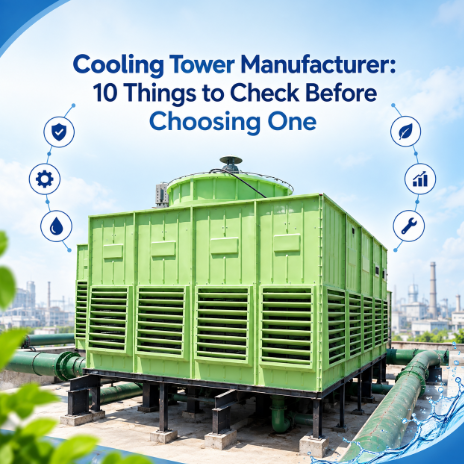
This makes choosing the right Cooling Tower Manufacturer an important decision for any industrial facility. A cooling tower is a long-term investment, so factors such as design, construction quality, cooling performance, energy consumption, maintenance, and after-sales support should be considered before making a purchase.
At SF Cooling Towers, we understand that every industrial application has different cooling requirements. Water flow, heat load, operating temperature, available space, and site conditions can all affect the type of cooling tower required. That is why selecting the right system starts with understanding the actual requirements of the plant.
Whether you are installing a new cooling system or replacing an existing tower, taking the time to compare the design, quality, performance, and support offered by different manufacturers can help you make a better long-term decision.
In this guide, we will look at the major factors to consider before choosing a cooling tower manufacturer and explain how businesses can select a system that delivers reliable performance.
What Is Cooling Tower Performance?
Cooling tower performance refers to how effectively a cooling tower removes heat from circulating water while maintaining the required cold-water temperature and keeping operating costs under control.
A well-performing cooling tower should be able to:
- Achieve the required cooling range and approach
- Maintain consistent cold-water temperature
- Handle the design water flow rate
- Operate with stable fan and motor performance
- Minimize water loss through drift and blowdown
- Control scaling, corrosion, and biological growth
- Keep energy and chemical consumption under control
Performance should not be judged by only one parameter. For example, a tower may provide adequate cooling but still consume excessive water or electricity.
That is why several operating parameters should be monitored together.
Key Parameters Used to Measure Cooling Tower Efficiency
Before discussing the factors that affect performance, it is useful to understand the main parameters operators normally monitor.
Cooling Range
Cooling range is the difference between the hot-water temperature entering the tower and the cold-water temperature leaving it. A reduction in range can indicate reduced heat load, changes in water flow, or problems with air distribution.
Approach
Approach is the difference between the cold-water temperature leaving the tower and the ambient wet-bulb temperature.
It can be calculated using:
Approach (°C) = Cold-Water Temperature − Wet-Bulb Temperature
For example, if the cold-water temperature is 32°C and the wet-bulb temperature is 27°C, the approach is 5°C. A smaller approach indicates better cooling performance.
Water Flow Rate
Water flow rate indicates how much circulating water passes through the tower.
Flow Rate (m³/hr) = Volume of Water ÷ Time
If 1,200 cubic metres of water circulates through the tower in one hour, the flow rate is 1,200 m³/hr.
Evaporation Loss
Evaporation loss is the amount of water lost as vapour during the heat rejection process. It is a normal part of cooling tower operation and is typically around 1% of the circulating flow for every 10°C of cooling range.
1. Cooling Requirement Is the Starting Point
The performance of any cooling tower begins with a clear understanding of the cooling requirement.
A cooling tower is selected according to the amount of heat that needs to be removed from the circulating water. Requirements can vary significantly depending on the process, the plant, and the operating conditions.
The basic information normally required includes:
- Water flow rate
- Heat load
- Hot-water temperature
- Cold-water temperature
- Wet-bulb temperature
- Operating hours
- Water quality
- Available installation area
An undersized tower may not provide enough cooling, while an oversized tower can increase the initial investment and may not provide any real benefit for the application.
This is why accurate information should be shared with the manufacturer at the beginning of the selection process.
2. Manufacturer's Technical Experience Matters
Experience is one of the first things you should look at when selecting an industrial equipment supplier.
A manufacturer with experience across different applications is more likely to understand the practical problems that can occur after installation.
Cooling towers are used in industries such as:
- Plastic processing
- Chemical manufacturing
- Steel
- Power
- Pharmaceutical
- Food processing
- HVAC
- Rubber
- Textile
- General manufacturing
Each application can have different cooling requirements. A good industrial cooling tower manufacturer should be able to understand your process instead of simply asking you to select a model from a catalogue.
Technical experience also becomes useful when there are changes in water quality, seasonal temperature variations, scaling problems, or changes in plant production.
3. Choosing the Right Cooling Tower Type
There are several cooling tower designs available, and each has its own advantages.
Common types include:
- Forced draft cooling towers
- Induced draft cooling towers
- Counterflow cooling towers
- Crossflow cooling towers
- FRP cooling towers
- Packaged cooling towers
The right choice depends on the application, available space, water flow, heat load, maintenance requirements, and environmental conditions.
For example, in an induced draft cooling tower, the fan is normally positioned at the air discharge side. The fan pulls air through the tower, allowing the water and air to come into contact for heat transfer.
A manufacturer should explain why a particular design is suitable for your plant instead of simply recommending the most commonly sold model.
The correct design can improve cooling performance and make maintenance easier over the long term.
4. Construction Material Has a Direct Impact on Durability
The construction material of a cooling tower has a direct effect on its durability and maintenance requirements.
Cooling towers operate in a wet environment. The structure is continuously exposed to water, humidity, chemicals, sunlight, and changing weather conditions.
This is one reason why FRP cooling tower designs are commonly considered for applications where corrosion resistance is important.
FRP is lightweight and offers good resistance to corrosion. However, the quality of the FRP construction still matters.
The resin, reinforcement, thickness, manufacturing method, hardware, and overall workmanship should be considered before making a decision.
Simply choosing a tower because it is made from FRP is not enough. The quality of the material and construction determines how well it will perform in actual operating conditions.
5. Quality of Cooling Tower Fill
The fill is an important internal component of a cooling tower.
Its main purpose is to increase the contact area between water and air. This gives heat more opportunity to transfer from the water to the air.
The type of fill should be selected according to the water quality and application.
If the circulating water contains dirt, suspended particles, or other contaminants, the wrong fill can become blocked over time. This can reduce airflow and water distribution and eventually affect cooling performance.
A good manufacturer will consider factors such as:
- Water quality
- Temperature
- Flow rate
- Heat load
- Scaling tendency
- Suspended solids
The fill should not be treated as a small component. It plays an important role in the actual cooling process.
6. Fan and Motor Selection
The fan is responsible for moving air through the tower, making fan selection an important part of the overall design.
The fan needs to provide enough airflow for the required cooling duty without using excessive power.
The motor also needs to be correctly matched with the fan and operating conditions.
When comparing cooling towers, look at factors such as:
- Fan size
- Airflow
- Motor power
- Fan speed
- Fan material
- Noise level
- Maintenance requirements
An efficient cooling tower fan can help maintain the required cooling performance while keeping electricity consumption under control.
This becomes especially important for plants where cooling towers operate for long hours every day.
A small difference in power consumption may not seem important at the time of purchase, but it can become a significant operating cost over several years.
7. Water Consumption and Water Treatment
Cooling towers use water as part of the heat rejection process, so water consumption should always be considered when selecting a system.
Water is mainly lost through evaporation. There can also be losses through drift and blowdown.
The actual amount of water required depends on factors such as:
- Heat load
- Cooling range
- Ambient conditions
- Cycles of concentration
- Water quality
- Tower design
Efficient operation is not only about reducing the amount of water used. The water chemistry also needs to be controlled.
Poor water quality can lead to scale, corrosion, and biological growth inside the system. These issues can reduce heat transfer and increase maintenance.
A proper cooling tower water treatment program can help control these problems and maintain better system performance.
8. Maintenance and Spare Parts Availability
A cooling tower is expected to operate for many years, so maintenance should be considered before purchasing rather than after installation.
Different components may require inspection, servicing, or replacement during the operating life of the tower.
These can include:
- Fan
- Motor
- Gearbox
- Fill
- Nozzles
- Drift eliminators
- Bearings
- Valves
- Water distribution system
The availability of spare parts can make a big difference.
Imagine a plant has stopped because of a small component failure, but the required spare part is not available for several weeks. The resulting production loss can be much higher than the original cost of the component.
This is why a manufacturer's maintenance support and spare-parts availability should be considered along with the equipment price.
9. Installation and Service Support
Good equipment can still perform poorly if it is not installed and commissioned correctly.
Installation should be carried out according to the manufacturer's recommendations. Fan alignment, water distribution, piping, electrical connections, vibration, and operating settings should all be checked before regular operation begins.
After-sales support is equally important.
If your plant is located in Delhi, having access to a Cooling Tower Manufacturer in Delhi can make site visits, technical support, installation assistance, and service more convenient.
However, local availability should not be the only factor. Product quality and technical capability should remain the priority.
A manufacturer that provides proper support after installation can help reduce downtime and solve operating issues more quickly.
10. Compare Total Cost Instead of Only Price
Price is important, but it should not be the only thing you compare.
Two cooling towers may have different purchase prices but very different operating costs.
The total cost can include:
- Equipment cost
- Installation cost
- Electricity consumption
- Water consumption
- Chemical treatment
- Maintenance
- Spare parts
- Fan and motor replacement
- Expected service life
For example, if one tower uses more electrical power every hour, the difference may become substantial over several years.
Similarly, a tower that needs frequent maintenance may appear cheaper initially but become more expensive to operate.
This is why it is better to look at the total cost of ownership rather than choosing equipment based only on the lowest quotation.
Why Choosing the Right Manufacturer Matters
A cooling tower is not a product that should be selected only by size or price.
The manufacturer needs to understand how the tower will be used and what conditions it will face.
Important factors such as water temperature, flow rate, heat load, ambient conditions, water chemistry, available space, and operating hours all affect the final design.
A manufacturer that studies these factors before recommending equipment is more likely to provide a solution that works properly in real operating conditions.
This approach can also help prevent common problems such as poor cooling, excessive water consumption, scaling, corrosion, high power consumption, and frequent maintenance.
Service Support After Installation
Installing a cooling tower is only the beginning. Proper service and support after installation are important to keep the system working smoothly over the long term. Regular inspection can help identify issues with the fan, motor, fill, water distribution system, and other components before they affect cooling performance.
A reliable manufacturer should be able to provide support for commissioning, routine maintenance, troubleshooting, and replacement of important spare parts when required. Quick technical assistance can also help reduce downtime if the cooling tower develops an unexpected problem.
For industrial plants, having access to a trusted Cooling Tower Manufacturer in Faridabad can be useful when regular service, maintenance, or on-site technical support is required. However, service quality and technical knowledge should always be considered along with the manufacturer's location.
Good after-sales support helps maintain cooling efficiency, extend equipment life, and keep maintenance costs under control. Before purchasing a cooling tower, it is therefore worth understanding what type of service and support the manufacturer will provide after installation.
Why Choose SF Cooling Towers?
At SF Cooling Towers, the focus is on providing cooling tower solutions according to the actual requirements of the application.
Every plant has different cooling conditions. Water flow, heat load, operating temperature, water quality, installation space, and working hours can all affect the type of cooling tower required.
Instead of treating every project the same way, SF Cooling Towers focuses on understanding the application and selecting suitable components and configurations.
The goal is simple: provide a cooling tower that can deliver reliable cooling, reasonable operating costs, and practical maintenance over its service life.
For customers looking for a Cooling Tower Manufacturer in India, choosing a supplier with a clear understanding of design, construction, performance, and service can make the entire buying process easier.
Final Thoughts
Choosing a cooling tower manufacturer is a decision that can affect your plant for many years.
Before finalizing your supplier, look beyond the initial price. Check the manufacturer's experience, cooling tower design, construction materials, fill quality, fan and motor selection, water consumption, maintenance requirements, spare-parts availability, installation support, and long-term operating cost.
A properly selected cooling tower can provide stable cooling and help keep the overall process running smoothly.
The right manufacturer will not simply sell you a tower. They will understand your requirements and help you choose a system that fits your actual application.
For this reason, take the time to compare your options carefully and discuss your complete cooling requirements before placing the order.
Frequently Asked Questions (FAQs)
Key factors include the manufacturer's technical experience, cooling tower design, construction material, fill quality, fan and motor selection, water consumption, maintenance requirements, spare-parts availability, installation support, and long-term operating cost.
The basic information includes water flow rate, heat load, hot-water temperature, cold-water temperature, wet-bulb temperature, water quality, operating hours, and available installation space.
The suitable type depends on the application. Forced draft, induced draft, counterflow, crossflow, and FRP cooling towers can all be suitable depending on the cooling requirement and operating conditions.
Cooling tower fill increases the contact area between air and water, which improves heat transfer and helps the circulating water cool more effectively.
Cooling tower efficiency can be affected by water flow, heat load, ambient temperature, wet-bulb temperature, airflow, fill condition, water distribution, fan performance, and water quality.
Water consumption can be managed through proper tower design, suitable cycles of concentration, blowdown control, drift reduction, and an effective water treatment program.
Maintenance frequency depends on the type of tower, operating hours, water quality, and site conditions. Regular inspection and preventive maintenance are recommended to identify problems early.
FRP can be a suitable choice for many cooling tower applications because it offers corrosion resistance and is relatively lightweight. However, the quality of the FRP construction and suitability for the application should be checked.
The fan provides the airflow needed for heat transfer. Proper fan and motor selection can help achieve the required cooling while keeping energy consumption under control.
Cooling towers are long-term operating equipment. Good after-sales service, spare-parts availability, installation support, and technical assistance can help reduce downtime and keep the system working reliably.