

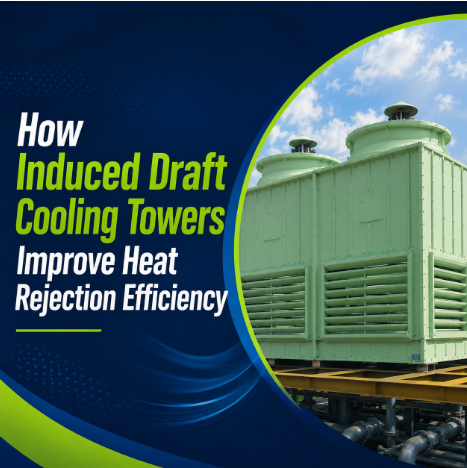
Induced draft cooling towers play an important role in industrial cooling systems where stable temperature control and efficient heat removal are required. These systems are widely used in process industries, HVAC plants, power units, and manufacturing facilities where continuous heat generation needs to be managed effectively.
Industrial infrastructure is growing rapidly, and the demand for efficient cooling systems is increasing. Many industries are now looking for reliable cooling tower solutions that can deliver consistent performance under heavy operating loads and continuous process conditions.
Understanding Heat Rejection in Industrial Cooling Systems
Heat rejection is the process of removing unwanted heat from water used in industrial operations. In cooling towers, warm water from industrial processes is cooled by exposing it to air flow, which allows heat transfer through evaporation and convection.
The efficiency of this process depends on airflow, water distribution, fill media design, and fan performance. Induced draft cooling towers improve this system by using mechanical fans placed at the top of the tower to pull air through the structure, ensuring better airflow control and heat exchange.
What Makes Induced Draft Cooling Towers Efficient
Induced draft cooling towers are designed to optimize airflow and reduce resistance in the cooling process. The fan located at the discharge point creates negative pressure, which draws air uniformly through the fill media.
This controlled airflow helps achieve better contact between air and water, resulting in improved evaporation and higher heat rejection efficiency.
Industries looking for induced draft cooling towers manufacturer in Faridabad often prefer this design because of its stable performance and energy-efficient operation.
Airflow Control and Heat Transfer Efficiency
One of the key advantages of induced draft systems is improved airflow distribution. Unlike natural draft systems, airflow here is mechanically controlled, ensuring consistent performance even under changing environmental conditions.
Uniform airflow improves the air-water interaction inside the fill media, which increases the cooling rate and enhances thermal efficiency.
This is one of the main reasons why Induced Draft Cooling Tower manufacturers in Faridabad focus on precision-engineered fan and fill systems to maximize heat rejection performance.
Role of Design in Performance Improvement
The design of induced draft cooling towers directly impacts efficiency. Key components such as axial fans, drift eliminators, water distribution systems, and fill media work together to improve heat exchange.
Proper design ensures:
Reliable Induced Draft Cooling Tower manufacturers focus on optimizing these parameters for industrial applications.
Energy Efficiency and Operational Stability
Energy consumption is a major concern in industrial cooling systems. Induced draft cooling towers are preferred because they offer better thermal efficiency with controlled fan operation.
Since airflow is managed at the discharge point, these systems reduce recirculation of warm air, improving cooling efficiency and reducing power usage.
This makes them suitable for industries looking for long-term operational savings and stable cooling performance.
Applications in Industrial Cooling Systems
Industrial growth across manufacturing, automotive, steel, and chemical sectors has significantly increased the demand for reliable thermal management systems. Industries require cooling solutions that ensure stable performance, energy efficiency, and continuous operation under heavy process loads.
Many plants depend on CTI Certified Induced Draft Cooling Tower Manufacturer in Faridabad solutions to maintain performance reliability, operational efficiency, and compliance with industry standards.
SF Cooling Tower continues to support diverse industries with engineered cooling systems designed for modern industrial requirements, ensuring durability, efficiency, and long-term performance.
Advantages of Induced Draft Cooling Towers
Induced draft cooling towers offer multiple benefits that make them widely used in industrial setups:
These advantages make them one of the most preferred cooling technologies in modern industries.
Why Industries Prefer SF Cooling Tower Solutions
SF Cooling Tower focuses on delivering performance-driven cooling systems designed for industrial reliability. With experience in thermal engineering and cooling tower design, the company provides systems that match industrial cooling demands across sectors.
Industries searching for Cooling Towers in Faridabad often choose engineered solutions that ensure durability, performance consistency, and long service life.
Maintenance and Long-Term Performance
Maintenance plays a critical role in cooling tower efficiency. Regular inspection of fans, fill media, water distribution systems, and drift eliminators helps maintain heat rejection performance.
Induced draft systems are relatively easier to maintain due to their accessible design and modular components.
Proper maintenance ensures consistent efficiency and reduces unexpected downtime in industrial operations.
Conclusion
Induced draft cooling towers are widely used in industries due to their ability to improve heat rejection efficiency through controlled airflow and optimized thermal design. Their performance stability, energy efficiency, and adaptability make them suitable for modern industrial cooling requirements.
With increasing industries across Delhi NCR including Noida, Gurugram, Faridabad, Ghaziabad, and industrial zones like Okhla, Bawana, Naraina, and Patparganj, demand for reliable systems such as induced draft cooling towers continues to rise. Manufacturers focusing on engineering precision and performance optimization play a key role in meeting this demand.
// Our Faq
Faq
An induced draft cooling tower uses a top-mounted fan to pull air through the system for efficient heat removal. It improves cooling performance through controlled airflow.
It works by drawing air through fill media using a fan, enabling heat transfer between water and air for effective cooling.
They are used for stable performance, better airflow control, and higher heat rejection efficiency in industrial systems.
They offer energy efficiency, consistent cooling, compact design, and reliable operation under heavy loads.
Induced draft pulls air through the system, while forced draft pushes air into it, affecting efficiency and airflow control.
They are used in power plants, chemical industries, manufacturing units, and HVAC systems.
Efficiency depends on design and airflow but generally offers higher heat rejection compared to natural draft systems.
With proper maintenance, it can operate efficiently for 15–25 years in industrial applications.
Regular maintenance, proper water treatment, and optimized airflow management improve overall performance.
SF Cooling Tower systems are used in manufacturing, HVAC, chemical, automotive, and heavy engineering industries for reliable cooling performance.