

Industrial cooling systems play an important role in maintaining process stability, protecting equipment, and supporting continuous production. When cooling tower maintenance becomes frequent or costly, it can affect both operating efficiency and plant productivity. Low Maintenance FRP Cooling Towers are designed to address many of these challenges through corrosion-resistant construction, durable components, efficient heat rejection, and practical maintenance requirements. FRP, or Fibre Reinforced Plastic, is particularly suitable for demanding industrial environments where moisture, chemicals, and varying operating conditions can affect conventional materials
For industries evaluating a new cooling system, understanding the construction, maintenance requirements, applications, and selection factors of FRP cooling towers can help in making a more informed decision.
What Is an FRP Cooling Tower?
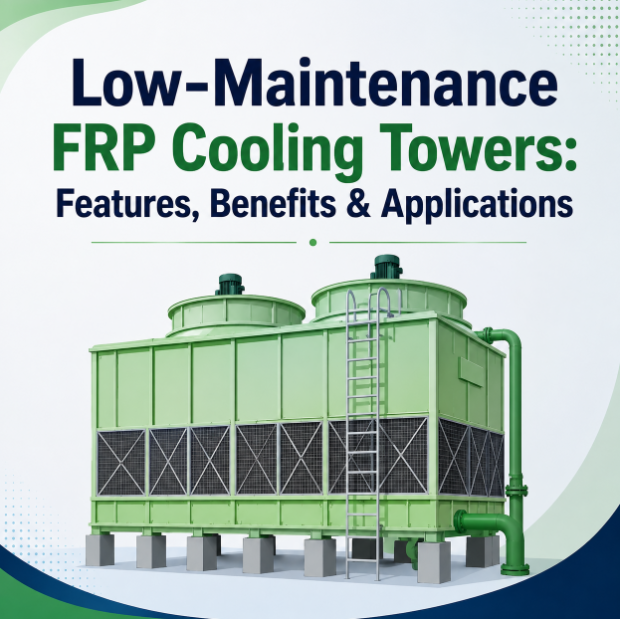
An FRP cooling tower is an industrial heat-rejection system that uses Fibre Reinforced Plastic (FRP) as a major construction material. Its primary function is to remove unwanted heat from circulating water and release that heat into the atmosphere.
In a typical cooling tower, warm process water enters the tower and is distributed over the fill media. A fan moves air through the tower, allowing heat to transfer from the water to the air. The cooled water is then collected and returned to the industrial process.
FRP is widely used in cooling tower construction because it offers useful properties such as:
- Corrosion resistance
- Good structural durability
- Resistance to moisture
- Relatively low maintenance requirements
- Suitability for demanding industrial environments
- Flexibility in cooling tower design
Depending on the application, FRP cooling towers can be designed in different configurations and capacities to meet specific heat-load and water-flow requirements.
Why Are FRP Cooling Towers Low Maintenance?
One of the major advantages of FRP cooling towers is their ability to withstand environmental and operating conditions that can cause corrosion
The FRP construction does not easily corrode or rust when exposed to moisture. This can help reduce some maintenance requirements associated with corrosion-related deterioration.
However, low maintenance does not mean maintenance-free. Regular inspection and maintenance of components such as fans, motors, fill media, water distribution systems, nozzles, and drift eliminators remain important for reliable operation.
A well-designed maintenance program can help identify problems early and maintain consistent cooling performance.
Key Features of Low-Maintenance FRP Cooling Towers
1. Corrosion-Resistant FRP Construction
Industrial cooling towers operate continuously in a wet environment. Depending on the process, the circulating water may also contain chemicals or contaminants that can accelerate corrosion.
FRP construction provides strong resistance to corrosion and moisture, making it suitable for many industrial cooling applications.
This characteristic can help reduce corrosion-related maintenance and support longer-lasting tower components.
2. Durable Components
A cooling tower's performance depends on more than its outer structure. Components such as the fan, motor, fill media, water distribution system, nozzles, and drift eliminators all contribute to overall performance.
Selecting appropriately designed and durable components can reduce unexpected maintenance requirements and support reliable operation.
3. Consider Ambient Weather Conditions
The primary purpose of a cooling tower is efficient heat rejection.
Fill media increases the contact area between water and air, while the fan provides the required airflow. Proper water distribution helps ensure that the available fill area is used effectively.
The overall cooling performance depends on factors such as:
- Heat load
- Water flow rate
- Entering and leaving water temperature
- Ambient wet-bulb temperature
- Airflow
- Fill design
- Water distribution
4. Easy Inspection and Maintenance
Maintenance becomes easier when important components can be inspected and accessed systematically.
Routine checks should include:
- Fan and motor condition
- Fill media
- Spray nozzles
- Water distribution
- Drift eliminators
- Basin condition
- Vibration and unusual noise
- Water quality
Regular inspections can help prevent minor issues from becoming major operational problems.
5. Reliable Water Distribution
Proper water distribution is essential for effective heat transfer.
The distribution system should spread water consistently over the fill media. Blocked nozzles, uneven water flow, or poor distribution can reduce cooling performance and increase operating problems.
Regular cleaning and inspection of the distribution system are therefore important parts of cooling tower maintenance.
Benefits of Low-Maintenance FRP Cooling Towers
Choosing a low-maintenance cooling tower can provide several operational advantages for industrial facilities.
Reduced Maintenance Requirements
FRP's corrosion resistance can reduce certain maintenance requirements compared with materials that are more susceptible to corrosion.
This can be particularly useful in continuously operating industrial environments.
Lower Operating Costs
Maintenance is only one part of cooling tower operating costs. Energy consumption, water management, component replacement, and downtime can also affect total operating expenses.
A properly selected and maintained cooling tower can support efficient operation and help control avoidable costs.
Corrosion Resistance
FRP is naturally resistant to corrosion and is therefore suitable for applications where moisture and aggressive environmental conditions are concerns.
Long-Term Durability
A cooling tower is a long-term industrial asset. Durable construction and appropriate component selection can support reliable operation over an extended service period.
Actual service life, however, depends on operating conditions, water quality, maintenance, installation, and component selection.
Reliable Cooling Performance
Consistent heat rejection is essential for maintaining the required process temperature.
A properly designed cooling tower helps provide dependable cooling under the conditions for which it has been selected.
Improved Operational Efficiency
Efficient airflow, water distribution, fill media, and heat transfer work together to improve cooling performance. This can contribute to better overall process efficiency.
Applications of FRP Cooling Towers
Industrial FRP Cooling Towers are used across a wide range of sectors where process or equipment cooling is required.
HVAC Systems
Cooling towers are commonly used in large HVAC and central cooling systems to reject heat from condenser water.
Plastic Manufacturing
Plastic processing equipment often requires continuous cooling to maintain appropriate operating temperatures. Cooling towers can support process cooling requirements in manufacturing facilities.
Chemical Processing
Chemical plants may operate with demanding temperature-control requirements. FRP construction can be useful where corrosion resistance is important.
Pharmaceutical Industry
Temperature control is important across pharmaceutical manufacturing and associated utility systems. Properly designed cooling systems can support stable plant operations.
Food Processing
Cooling systems are used in various food and beverage processing applications where reliable temperature management is required.
Power Generation
Cooling towers can be part of heat-rejection systems used in power generation and associated industrial processes.
Heat Exchangers
Cooling towers can provide cooling water for heat exchangers used to transfer heat from industrial processes.
General Process Industries
Many manufacturing facilities require continuous cooling for machinery, processes, compressors, condensers, and other equipment.
How to Reduce Cooling Tower Maintenance Costs
Even a low-maintenance cooling tower requires proper care. The following practices can help control maintenance requirements:
Maintain Proper Water Quality
Poor water quality can contribute to scaling, fouling, corrosion, and biological growth. Regular water treatment and monitoring can help protect cooling tower components.
Inspect Fans and Motors
Fans and motors are critical mechanical components. Check for unusual noise, vibration, overheating, and other signs of abnormal operation.
Check Fill Media
Blocked or damaged fill media can affect water-air contact and reduce heat-transfer performance. Regular inspection helps maintain effective operation.
Clean Water Distribution Systems
Nozzles and distribution pipes should be checked periodically for blockage or uneven water distribution.
Inspect Drift Eliminators
Damaged or improperly positioned drift eliminators can affect water carryover and system performance.
Follow a Preventive Maintenance Schedule
Scheduled inspections are generally more effective than waiting for a component to fail. Maintenance intervals should be based on the manufacturer's recommendations and actual operating conditions.
How to Choose the Right FRP Cooling Tower
Choosing an FRP Cooling Tower Manufacturer in India is only one part of the selection process. The cooling tower itself must be correctly designed for the application.
Consider the following factors:
Heat Load
Determine the amount of heat that needs to be rejected. The cooling tower should be selected according to the actual process heat load rather than only the equipment size.
Water Flow Rate
The required circulating-water flow rate is an important factor in cooling tower selection and design.
Entering and Leaving Water Temperature
The required temperature reduction, or range, directly influences cooling tower performance and selection.
Wet-Bulb Temperature
Ambient wet-bulb temperature is a key design parameter because it affects the achievable cooling-water temperature.
Installation Environment
Available space, airflow conditions, ambient conditions, water quality, and accessibility should all be considered before installation.
Material Quality
For demanding industrial applications, corrosion-resistant FRP construction can provide important advantages.
Fan and Motor Selection
Fan and motor configuration affects airflow, cooling performance, power consumption, and maintenance requirements.
Maintenance Requirements
Consider accessibility of components and the availability of spare parts and technical support.
Manufacturer Support
A reliable FRP Cooling Tower Supplier in India should be able to understand the application, recommend an appropriate design, and provide technical support when required.
Why Choose a Reliable FRP Cooling Tower Manufacturer?
The performance of a cooling tower depends heavily on correct design, manufacturing quality, component selection, and application-specific engineering.
Superflow Cooling Towers Pvt. Ltd. is a CTI-Certified manufacturer of FRP cooling towers and industrial cooling solutions, serving customers across India.
Based in Faridabad, Haryana, the company provides cooling solutions for a range of industrial applications. Its focus is on delivering dependable cooling systems designed around the operating requirements of individual projects.
When evaluating an FRP Cooling Tower Manufacturer in Faridabad or elsewhere in India, businesses should look beyond the initial purchase price and consider:
- Cooling performance
- Construction quality
- Corrosion resistance
- Component reliability
- Maintenance requirements
- Spare parts availability
- Technical support
- Application-specific customization
- Long-term operating value
A suitable cooling tower should be selected according to the actual process conditions rather than simply choosing the lowest-cost option.
Conclusion
Low Maintenance FRP Cooling Towers can be a practical choice for industries looking for corrosion-resistant construction, dependable heat rejection, and manageable maintenance requirements.
However, low maintenance performance depends not only on the FRP structure but also on correct tower selection, water quality, component quality, operating conditions, and preventive maintenance.
For industrial facilities across India, selecting the right FRP Cooling Tower Manufacturer can make a significant difference to long-term cooling performance and operational reliability.
Superflow Cooling Towers Pvt. Ltd., a CTI-Certified manufacturer based in Faridabad, Haryana, provides industrial FRP cooling tower solutions for customers across India.
Frequently Asked Questions (FAQs)
An FRP cooling tower is a heat-rejection system that uses Fibre
Reinforced Plastic as a major construction material and removes heat
from circulating water through air-water interaction.
FRP offers good resistance to corrosion and moisture, which can reduce certain corrosion-related maintenance requirements. Regular maintenance of mechanical and water-system components is still necessary.
Yes. FRP cooling towers are used across industries such as HVAC, plastics, chemicals, pharmaceuticals, food processing, power generation, and general process industries.
Proper water treatment, preventive maintenance, regular inspection, timely cleaning, and appropriate component selection can help reduce avoidable maintenance costs.
Yes. FRP generally provides strong resistance to corrosion and moisture, making it suitable for many industrial environments.
Cooling efficiency depends on several factors, including airflow, water distribution, fill media, heat load, water flow, and ambient conditions. Proper tower design brings these factors together for effective heat rejection.
Important factors include heat load, water flow rate, temperature range, wet-bulb temperature, installation conditions, water quality, fan and motor requirements, and maintenance accessibility.
CTI certification or validation relates to cooling tower thermal performance according to applicable Cooling Technology Institute programs and requirements. Buyers should verify the specific certification or validation applicable to the model being considered.
Cooling towers can be engineered or configured according to project-specific requirements such as heat load, water flow, operating temperatures, installation conditions, and space constraints.
Industrial buyers can evaluate manufacturers based on technical capability, relevant certifications, product quality, application experience, after-sales support, and ability to provide a suitable solution for their operating conditions.