

A cooling tower works only as well as its water distribution system. If water does not spread evenly over the fill media, the tower cannot cool properly. Efficiency drops, energy use rises, and problems start appearing one after another.
In this blog, we will clearly explain the water distribution system used in cooling towers — its main parts, how it works, and the common issues that occur. We will also share simple ways to avoid these problems.
Whether you manage a plant or are looking for a reliable cooling tower manufacturer in India, understanding this system helps you make better decisions.
What is a Cooling Tower Water Distribution System?
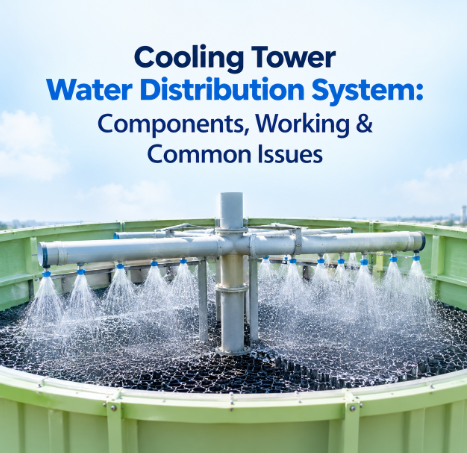
The water distribution system is the network that takes hot water from the process and spreads it evenly over the fill media inside the cooling tower.
Its main job is simple:
- Receive hot water
- Distribute it uniformly
- Allow maximum contact between water and air
When distribution is even, heat transfer improves. When it is uneven, parts of the fill stay dry, cooling capacity falls, and the system works harder than needed.
Main Components of the Water Distribution System
A typical water distribution system has a few important parts. Let’s look at each one in simple words.
1. Inlet Pipe / Header Pipe
Hot water first enters through the inlet pipe. This pipe carries water from the process or heat exchanger into the cooling tower. It is usually made of PVC, FRP, or mild steel depending on water quality and tower size.
2. Distribution Basin or Hot Water Basin
In many crossflow towers, water collects in a basin on top. From here, it flows down through nozzles or orifices. In counterflow towers, the basin is often replaced by a network of pipes.
3. Spray Nozzles or Distribution Nozzles
These are the most critical parts. Nozzles break the water into small droplets or a fine spray so it spreads evenly over the fill. Good nozzles resist clogging and give a uniform pattern.
4. Lateral Pipes or Branch Pipes
In pipe-type systems, main headers feed smaller lateral pipes. These laterals carry water to individual nozzles. Proper sizing of laterals is important so every nozzle gets enough pressure.
5. Orifices or Diffuser Plates
Some designs use simple holes (orifices) instead of nozzles. Diffuser plates help spread water more evenly in certain tower types.
6. Flow Control Valves
Valves help balance water flow between different sections of the tower. They are useful when the tower has multiple cells.
All these parts work together. If one part fails or gets blocked, the whole distribution suffers.
How the Water Distribution System Works
The working is straightforward:
- Hot water from the process enters the cooling tower through the inlet pipe.
- Water reaches the distribution basin or pipe network.
- Pressure pushes water through nozzles or orifices.
- Water sprays or flows in a uniform pattern over the fill media.
- Air moves through the fill (either by fan or natural draft) and cools the water.
- Cooled water collects in the cold water basin at the bottom and returns to the process.
The key to good performance is even coverage. Every square metre of fill should receive roughly the same amount of water. Dry spots mean lost cooling capacity. Overloaded spots can cause flooding and higher pressure drop.
In FRP cooling towers, the distribution system is often designed for low maintenance and good corrosion resistance, which is one reason many industries prefer them.
Common Issues in Water Distribution Systems
Even a well-designed system can face problems over time. Here are the most frequent ones:
1. Clogged Nozzles
This is the number one issue. Dirt, scale, biological growth, or debris blocks the nozzles. Result: uneven spray, dry areas on the fill, and higher water temperature.
2. Uneven Water Distribution
Caused by blocked nozzles, damaged laterals, wrong nozzle orientation, or poor design. Some parts of the fill get too much water, others get too little.
3. Low Pressure at Nozzles
If the pump is weak, pipes are undersized, or valves are partly closed, water does not spray properly. Droplets become large and cooling efficiency drops.
4. Broken or Missing Nozzles
Nozzles can crack, get damaged during maintenance, or fall off. Missing nozzles create large dry zones.
5. Scale and Deposits Inside Pipes
Hard water leaves scale on the inner surface of pipes and nozzles. Flow reduces and distribution becomes irregular.
6. Leaking Joints or Cracked Pipes
Leaks waste water and reduce pressure in the system. In FRP systems, improper installation or impact damage can cause cracks.
7. Improper Nozzle Orientation
Nozzles must face the correct direction. If they are turned or installed wrongly, the spray pattern suffers.
8. Algae and Biological Growth
In open systems, algae can grow inside basins and pipes, leading to blockages and bad odour.
These problems slowly reduce the cooling capacity of the tower. Energy consumption increases because the system has to run longer or at higher load to achieve the same cooling.
Simple Ways to Avoid These Problems
Prevention is always better and cheaper than repair. Here are practical steps:
- Inspect nozzles regularly (at least once a month).
- Clean or replace clogged nozzles immediately.
- Keep the water treatment programme active to control scale and algae.
- Check water pressure at the distribution level.
- Ensure all nozzles are of the same type and correctly oriented.
- Flush the distribution pipes during shutdowns.
- Use good quality strainers before the tower to catch debris.
- Train operators to notice changes in water temperature or fan load.
A well-maintained distribution system can keep the cooling tower running close to its design capacity for many years.
Why Proper Design Matters
Not all distribution systems are equal. A poorly designed system will give trouble from day one. Good design considers:
- Correct nozzle type and spacing
- Adequate pipe sizing
- Easy access for cleaning
- Material that resists corrosion
- Compatibility with expected water quality
When you choose a cooling tower, ask the supplier about the distribution system design. A company that pays attention to these details usually delivers better long-term performance.
Superflow Cooling Towers – Focused on Reliable Performance
At Superflow Cooling Towers, we design FRP cooling towers with careful attention to the water distribution system. Our nozzles, piping, and basins are selected for uniform coverage, easy maintenance, and long service life.
As a trusted FRP Cooling Tower Suppliers in Faridabad, we supply towers for a wide range of industries — chemical, pharmaceutical, power, plastic, food, and HVAC. Our focus remains on practical designs that work well in Indian conditions and reduce downtime for the customer.
Final Thoughts
The water distribution system may look simple, but it has a big impact on cooling tower performance. Even distribution means better cooling, lower energy use, and fewer breakdowns.
Regular inspection, timely cleaning, and proper water treatment can prevent most common issues. When selecting a new tower or upgrading an old one, give importance to the quality of the distribution system.
If you are planning a new installation or facing problems with your existing tower, feel free to reach out to Superflow Cooling Towers. We are happy to help you choose the right solution for your needs.
Frequently Asked Questions (FAQs)
An FRP Cooling Tower is a cooling system made from Fibre Reinforced Plastic. It is lightweight, corrosion-resistant, and widely used in industries for cooling process water.
FRP Cooling Towers are lighter, last longer, need less maintenance, and do not get damaged by water or chemicals easily. They also offer better efficiency in most industrial applications.
Yes. Our FRP Cooling Towers are designed for Indian industrial conditions and work well for factories, chemical plants, pharma units, and HVAC systems in and around Faridabad.
Yes, we offer CTI Certified FRP Cooling Towers that meet international performance standards for reliable and efficient cooling.
We manufacture FRP Cooling Towers in a wide range of capacities — from small commercial units to large industrial systems based on the customer’s cooling requirement.
With proper maintenance, a good quality FRP Cooling Tower can easily last 12–15 years or more.
Yes, we provide complete support including supply, installation guidance, and after-sales service for customers in Faridabad and nearby areas.
Common issues include nozzle blockage, scaling, uneven water distribution, and fan-related problems. Most of these can be avoided with regular maintenance.
Yes, but proper water treatment is recommended. High TDS can cause scaling, so a good water treatment system helps maintain performance.
You can contact Superflow Cooling Towers with your cooling load, water quality, and application details. Our team will share a suitable offer quickly.